Images | Archived scripts and data files
This page contains images, code files (scripts), and data files used in the background notes, publications, and underlying research for the tilings projects. Many of the files, especially code and data files are stored in a Google Drive folder constructed especially for this site.
Images
Surfaces and tiled surfaces | Hyperbolic tilings | Divisible Tilings | Billiards
Though many of the images may be directly viewed on this tilings site, all of the images are stored are in this Google Drive images folder.
Surfaces and tiled surfaces
The images are also stored in this Google Drive images folder.
| genus two surface | genus2.gif | genus2.eps |
| icosahedral tiling of sphere | icos.gif | icos.eps |
| (2,4,4) tiling on a torus | torus244.gif | torus244.eps |
| (3,3,3) tiling on a torus | torus333.gif | torus333.eps |
Hyperbolic tilings
The images are also stored in this Google Drive images folder.
| (2,4,5)- tiling of the hyperbolic plane | tt245.gif |
| (2,5,5)- tiling of the hyperbolic plane | tt255.gif |
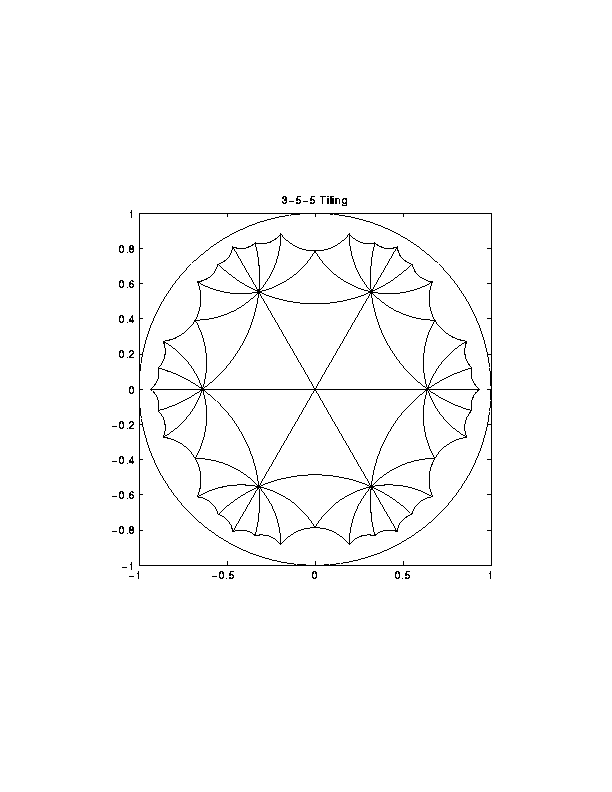
| (3,5,5)- tiling of the hyperbolic plane | t355.gif |
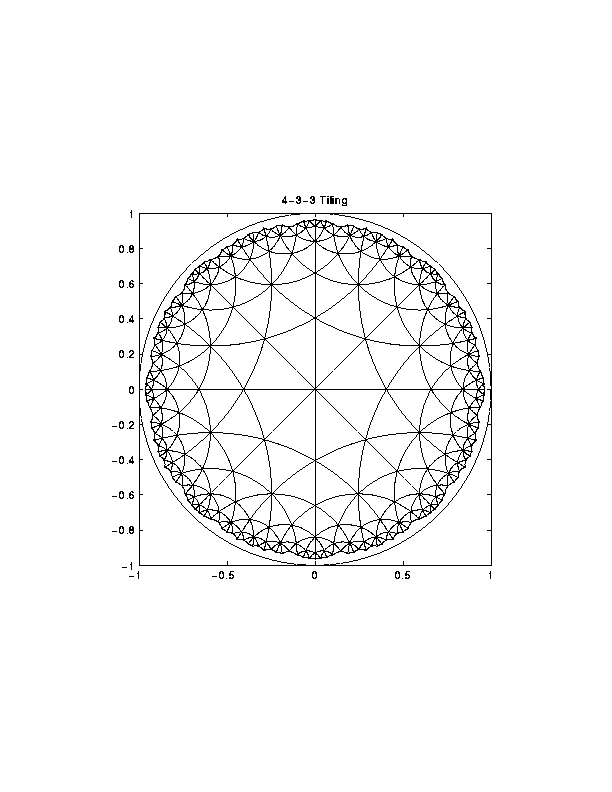
| (4,3,3)- tiling of the hyperbolic plane | t433.gif |
Divisible tilings
A tiling (coarse tiling) is divisible if it can be divided into a finer kaleidoscopic tiling (fine tiling). An example is the coarse tiling of the torus by rectangles refined by the fine tiling of (2,4,4) triangles.
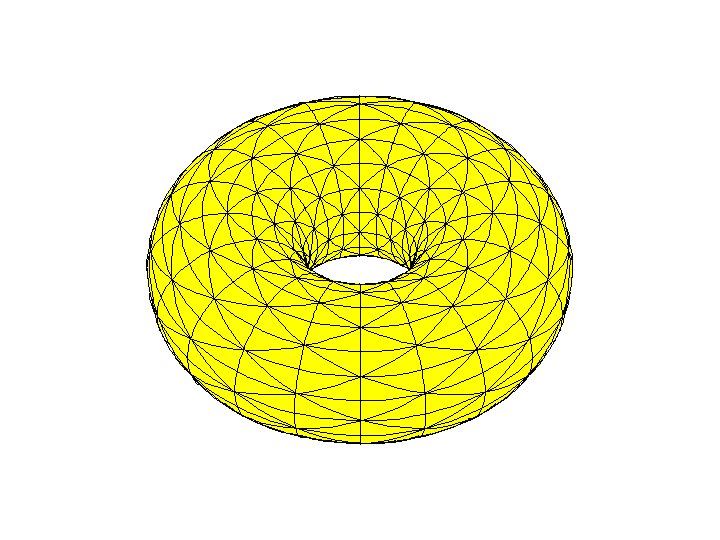
Each divisible tiling of a hyperbolic surface comes from a divisible tiling of the hyperbolic plane. All such tilings in which the tiles are triangles or quadrilaterals have been classified in the online paper:
Dawn M. Haney, Lori T. McKeough, Brandy M. Smith, Allen Broughton, New York Journal of Mathematics 6 (2000), 237-283. (link to journal, link to paper). The divisible tilings in the paper are listed in four groups, given below. In each group we have a picture file from the paper. In the picture files, each panel shows a kaleidoscopic coarse tile subdivided by fine tiles. The tiling of the entire plane is obtained by repeated reflection in the sides of either the coarse tile or the fine tiles. The caption of each divisible tiling example describes the types of the coarse and the fine tiles. The number K in each caption is the ratio of areas of the coarse and fine tiles, i.e., the number of fine tiles in a coarse tile. If the tiles in a panel have parameters in their description, then there is an infinite family of divisible tilings, and we say that the vertices with parameters are free vertices. In the contrary case with no parameters, all the vertices are constrained and there is only one tiling. The notions of free and constrained vertices are fully discussed in the paper.
Four groupings of divisible triangle and quadrilateral tilings.
- Eight cases of tilings of triangles by triangles. There are six infinite families with free vertices and two exceptional cases: Picture file.
- Thirty four cases tilings of quadrilaterals by triangles with free vertices. Because there are free vertices each one gives rise to infinite family of divisible tilings: Picture file.
- Twenty seven tilings of quadrilaterals by triangles with constrained vertices. Because all the vetices are constrained, there are no families: Picture file.
- Two tilings of quadrilaterals by quadrilaterals: Picture file.
The component images in the picture files above are in this Google Drive image folder.
Billiard images
Archived scripts and data files
Background notes scripts | Project scripts and data
This section contains links to various code files (scripts, as I call them) and data files used to investigate tilings on surfaces. The archives, located in this Google Drive scripts and data folder, are organized by the background notes and the various project areas in the first two columns of the jump table below. Each link in the jump table will take your to a more detailed table later on in this webpage. In these later tables there some direct links to the more important files. The other links in the will take you to the appropriate folder on the Google drive.
In the third columns of the jump table the interpretation of various file extensions is explained; only .mws, .m, .mat, .pdf, and .eps are standard. All files except Matlab data files, are simple text files. A library script or function library file is a package of related functions readable by the appropriate application, say Maple or Magma. Some of the scripts are older and may need revision to work properly.
Jump and information table
| Background Notes | Research Project Areas | File Extension Interpretation |
| image drawing scripts | low genus classification – triangles – quadrilaterals – branching data | .mws Maple worksheet.mpl Maple scripts and Maple library scripts |
| various constructions | divisible tilings | .m Matlab script.mat Matlab data file |
| geodesics, length spectrum and billiards | .mgm Magma scripts and library scripts.act .bdat .dat .rez various text data files .log transcript file | |
| moduli | .pdf portable document format.eps encapsulated post script | |
| ovals | ||
| separability of symmetries separability of symmetries – graphs | ||
| tiler (create tilings with Matlab) |
Background Notes – Scripts
The scripts below were used to make images and perform calculations for the background notes.
Producing Images
| icos.mws | icosahedral tiling of the sphere |
| torus244.mws | (2,4,4) tiling on the torus |
| torus333.mws | torus333.mws (3,3,3) tiling on the torus |
| genus2.mws | surface of genus two |
| triang4.mws | master tile (needs gtools.mpl) |
Various Constructions and Derivations
| Hgeom.mws | Geometric constructions |
| DHgeom.mws | Invariance and distance calculations for the disc |
| UHgeom.mws | Invariance and distance calculations for the upper half plane |
| NSchwartz.mws | NSchwartz.mws Numerical calculations for Schwartz triangles |
| schwartz.mws | Symbolic Calculations for Schwartz triangles |
Project scripts and data
Each of the sections below corresponds to one of the research project themes. Definitions and discussions needed to understand the files can be found in the background notes and in the student and other publications referenced the project themes overview.
Low genus classification of tilings and branching data for tilings
Triangle tilings
The files following are data files describing low genus tiling groups, corresponding to tilings by triangles. All files are text files in the given folder.
| abelian2.act | two generator abelian rotation group actions |
| cyclic.act | cyclic group rotation group actions |
| perm.act | non-solvable rotation group actions |
| pgroupNA.act | non-abelian p-group rotation group actions |
| solvableNANP.act | non-abelian non-p-group solvable rotation group actions |
The following scripts are used to compute tiling groups, corresponding to tilings by triangles. All files are text files in the given folder.
| A5.mgm | sample script to find (2,3,5) – tilings of the sphere with G = Alt(5) |
| tileclass.mgm | function library for computing tilings and calculating “theta” |
| tilerun.mgm | master driver for tiling classification program |
| abelian2.mgm | find two generator abelian rotation groups |
| cyclic.mgm | find cyclic rotation groups |
| perm.mgm | find non-solvable rotation groups (permutation group format) |
| pgroupNA.mgm | find non-abelian p-group rotation groups (PC format) |
| solvableNANP.mgm | find non-abelian non-p-group solvable rotation groups (PC format) |
Quadrilateral tilings
| quadclass.mgm | function library for computing tilings and calculating “theta” |
| quadrun.mgm | master driver for tiling classification program |
| data folder | Files are the form quads.vectors where s is the genus. Each entry contains branching data, group presentation, generating vectors and the tiling status of the (k,l,m,n), ( k,m,l,n), and (k,l,n,m) twists of a generating vector . |
| scripts folder | scripts and also contains some branching data input files |
Branching data
| bradatpoly.mws | finds branching data for small polygons and low genus |
Divisible tilings
The final images for the divisible tilings were constructed from the intermediate result files listed in the first table and Matlab tiling scripts listed in the second table.
| Boundary Construction | .rez and .log files containing information on all divisible quadrilaterals constructible by the boundary construction method |
| Direct Construction | .mpl files containing information on all divisible quadrilaterals constructible by the direct construction method |
| Images | folder containing divisible quadrilaterals constructible by direct construction methods as .mpl files |
| Boundary Construction | folder of Maple scripts to determine divisible quadrilaterals by boundary construction method (also contains .rez and .log files ) |
| Direct Construction | folder containing Maple scripts to determine divisible quadrilaterals by associated polygon methods (contains results as .mpl files ) |
| tiling m-file folder | folder of Matlab scripts that draw tilings by triangles |
Geodesics, length spectrum of a surface, and billiards
| Data Folder | (reduced words for translations and glides) |
| Images Folder | (billiards, .eps files) |
| billiardpics.mws | billiard drawing program for figures |
| billiardtest.mws | billiard drawing program with various tests |
| billiardsearch.mgm | Magma program to find generating words for billiard |
Moduli
Ovals and Oval Intersections
\Tilings with Matlab\
The scripts in this folder allow one to create and draw triangular
tilings, according to a tiling word. The main scripts are mtess.m
for creating tiling words and ttess.m for drawing tilings according
to a word.
 Tilings, Geometry and Automorphisms of Surfaces